





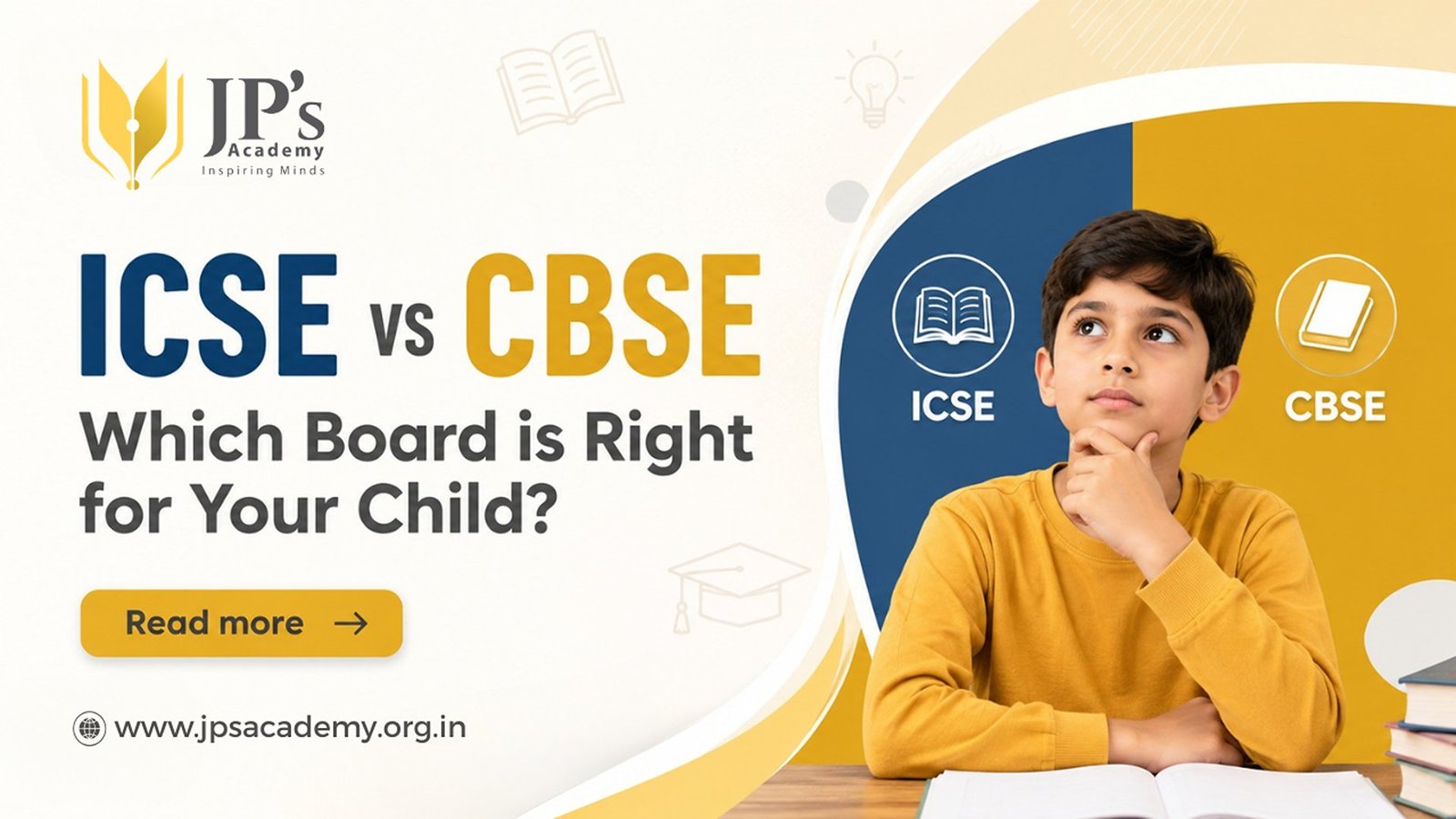
ICSE vs CBSE: Which Board is Right for Your Child?
Table of Contents
ToggleWe get this question at every admission season, from parents who have already asked five other people and gotten five different answers. ICSE or CBSE? Which one should we go for? Honestly, the question does not have a perfect answer here, and anyone who gives you a definite one is probably oversimplifying the issue. What matters is understanding what each board actually does differently, and matching that to your child, not to what worked for someone else's kid.
People tend to make the decision such that it is a matter of life and death, but truly, it isn't. However, it does matter, and it is good if you take thirty minutes of serious thought for the decision instead of just following the neighbor or someone else's child's example
What ICSE and CBSE Actually Are
CBSE (or Central Board of Secondary Education) is a government-run board of education that most schools in India, as well as many other countries, follow. It is the board around which most of the competitive exams are developed. JEE, NEET and in most of the state entrance tests, they heavily rely on the NCERT curriculum, which itself is based on the concept that the CBSE has been following for a long time.
ICSE (or Indian Certificate of Secondary Education) is a certificate run by a private body, known as the Council for the Indian School Certificate Examinations. ICSE is famous for having a more extensive syllabus, covering more disciplines and a great emphasis being laid on languages (in particular, English). It is not uncommon for students to say that they study the same topic more in-depth using an ICSE textbook compared to what is covered under CBSE when they are both taught the same topic.
There is no one answer to whether one board is better, harder or easier. They are both the outcome of different priorities only.
Where the Two Boards Really Differ
The Syllabus
CBSE keeps things fairly narrow and exam-focused. It is also very much based around the books of NCERT which, in fact, facilitates the use of materials for coaching, the availability of past papers, etc. In fact, just about all competitive exam related resources in the country have been based on this syllabus.
ICSE is usually a little broader. There is an increase in the number of subjects at the Class 10 level and a greater depth in the study in each subject. There is also more emphasis on projects and practicals. Some parents may see it as too heavy for a child who is not naturally very academic minded. But others would see it as something that a curious child would find very engaging.
The Language and Writing Focus
This is an aspect where ICSE is superior. The majority of people who completed both educational boards will agree to this. The English syllabus of ICSE is tougher; literary pieces are treated more seriously; as a result, students tend to be much better writers. This should be important if your child is pursuing arts/literature/law/journalism or anything related to language.
The Exam Style
CBSE exams are quite simple-minded. For example, a question repeats every couple of papers, the marks given are quite standard and a student having practiced a couple of sample papers would, in general, be able to figure out what was coming in the main exam. On the other hand ICSE exams test you not only on the content but also on how you put it in a different or creative way to express knowledge and it is quite the same as in an aptitude or an Olympiad exams. It is not that one way is better than another. Just different types of learners benefit from different approaches.
Which Board Suits Which Kind of Child
Rather than figuring out which board is better you could focus on asking yourself what your child needs at this moment.
- If your child has a pretty strong idea of going into engineering or medicine, CBSE is the short path. Syllabi and requirements are more or less the same with CBSE and JEE/NEET so switching to coaching based on CBSE is quite easily possible.
- If reading, writing debating or generally your child prefers delving deeply into a subject rather than going through it in a hurry then ICSE would be a better choice since it nurtures that kind of personality.
- If the family plans to move cities/countries during school years, CBSE is much more common all over India as well as abroad, so switching back and forth will be less of a hassle.
- If your child is finding it tough to cope with huge amounts of coursework and is far more comfortable with smaller workload and a focused syllabus, then CBSE is a better option as it is easier on the child.
You need to understand that none of these four points are set regulations. It is not unknown that many ICSE students have scored well JEE every year, or many CBSE students have turned out as excellent writers. One should remember that the above points talk about general trends and not guaranteed results.

Can You Switch Boards Later?
Absolutely. Besides this fact being important for parents not to overthink about their child's schooling, it's also a reality that such a change is easy and manageable when one goes from one board to the other at the levels close to Classes 8 and 9. At the time of writing this, the board's syllabi are only beginning to be shaped according to the requirements of board exams.
If it comes down to an issue during class 10 boards only, the whole situation is changed. At that point in time, the syllabus, the exam format, and the internal evaluation methods are all finalised, and changing would really be a major disruption. If an idea of switching over is under consideration, sooner is better.
What This Means If JEE or NEET Is the Goal
Usually, this is exactly what parents are trying to figure out. It's not quite them looking for which board is a more academic experience that they are really interested in; it is more the boards that will give their child a better shot at engineering or medical entrance exams
Here CBSE's a practical advantage that can be argued as quite real due to the syllabus commonality with NCERT Most of the coaching institutes including ones that provide the basic or foundation programs for Classes 9 and 10 are designed on the assumption of that a CBSE or CBSE-aligned background. So, the lack of competition from NCERT in terms of syllabus cannot prevent the ICSE students from competing many of them do and win. However, generally, such students put more efforts to understand and bridge the areas where their syllabus differs from the standard of the competition or exams.
If preparation for the entrance examinations is the main focus from the very beginning, CBSE will definitely be able to reduce one hurdle, otherwise it would still be better and not disadvantageous.
How to Actually Decide
Absolutely skip surveys and forum threads. Just take some time to sit and answer.
- Does your child prefer problem solving where the child gets the correct answer through practice or are they drawn more to reading and writing activities?
- Have the child's interests pointed strongly in a certain direction like engineering, medicine, or the child is definitely going to take competitive exams?
- Is the child getting into the right level of work without burning out?
- Do you see relocation as a possibility during the period when the child is attending school?
- Can you make an accurate comparison of the localities of different educational boards? Generally, the best CBSE school would surpass a mediocre ICSE school and vice versa. The same goes for other boards.
This last bit has been overlooked so many times. Everyone goes on arguing about educational mediums at the general level, forgetting to bring up the fact that differences in quality and learning atmosphere often depend more on a particular school and teachers.
A curriculum provides the skeleton only. It's a school where the flesh and muscles of teaching and learning are actually brought to life.
The Bigger Picture
Boards get treated like permanent decisions that shape a child's entire future. But the truth is that these boards have just one role among many. A lot is going to depend on how a kid utilises their school years, what kind of habits they adopt, which areas of study really get them excited, as well as how well they are supported through the different stages.
Therefore, you should not look at the neighbouring family's child or at which one would sound more glamorous at the dinner guests but go with what suits your child's personality and also the environment of your household currently.
Pick the board that will allow your child to actually enjoy the upcoming years at school.
At JP's Academy in Chembur, our PCMB program for Class 7 to 10 covers both ICSE and CBSE, so this is not a theoretical question for us, we work with students from both boards side by side every batch. Batches are capped at 18 students, which means a mentor actually knows where each child is stuck rather than guessing. That is the whole idea behind Mentorship Ki Taakat, our approach at JP's. Whether your child walks in from an ICSE classroom or a CBSE one, the board matters far less than whether someone is actually paying attention to how they are learning.
Frequently Asked Questions
Q - Is ICSE harder than CBSE?
A - Not harder exactly, just structured differently. ICSE covers more ground and asks more of a student's writing and application skills. CBSE is more compact and more predictable. Difficulty ends up depending on the student more than the board.
Q - Does the board matter for college admissions?
A - For most Indian universities and competitive exams, no. Both boards are equally recognised. What matters is the percentage or aggregate a student scores, and how that converts under each university's own equivalence process.
Q - Is CBSE really better for JEE and NEET preparation?
A - It has a practical edge because of syllabus overlap with NCERT, which most coaching material and entrance exams are built around. ICSE students can and do prepare just as well, they usually just need a bit more bridging work in the early stages.
Q - What if my child has already started in one board and we are having second thoughts?
A - If your child is still in the early middle school years, a switch is manageable. Once board exam years are close, it is usually better to stay put and focus energy on making the most of the board they are already in, rather than restarting the adjustment process.
 Summarize this article with: