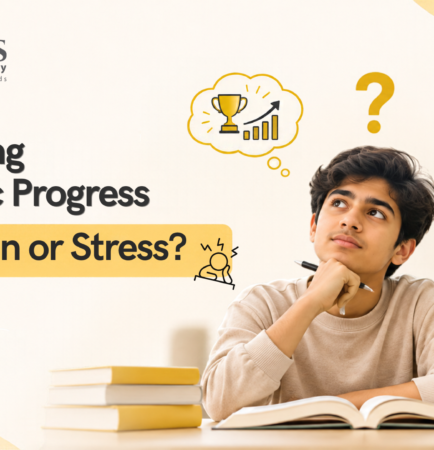











Is Comparing Your Progress with Friends Motivating or Stressful?
Table of Contents
ToggleResults are out, and as soon as you see them, before you even think about your own results, you're wondering what your best friend got.
Everyone does it, even though no one wants to admit it.
The moment you know their exam results, that is when your emotions for the whole day have been decided one way or the other. On one side of the spectrum, their high score inspires you to work harder and do better. On the other hand, it can completely throw your confidence off and you would end up in a bad mood.
So is comparing yourself with friends a good thing or a bad thing? Let’s figure it out.
Why Students Compare Their Progress with Friends
You sit in the same class, solve the same papers, and get the same marks list. Surely you will compare yourselves. No one needs to teach you this. Your friends are the easiest yardstick you’ve got.
Around exam time it is normal for this kind of stress to increase even more because we do not feel secure or confident about much. You are always wondering whether you are prepared enough so you tend to look at your classmates to get an idea. If you see others managing fine, you feel a little more comforted. But if they appear to be ahead of you, then you feel the need to catch up, or possibly get more worried.
It turns out that almost all of us shared this behavior as teenagers, so there is no need to feel ashamed of it.
When Comparing with Friends Can Motivate You
A little comparison can be useful. In our experience it works when a few things are true:
• You measure yourself against friends at a similar level, not the top ranker in class.
• You pay attention to their habits, how they revise or go back over mistakes, instead of obsessing over their marks.
• You stay curious about how they improve instead of feeling jealous.
• You take one small, concrete action to get better.
Suppose a friend beats you by 20 marks in Physics. Instead of sitting in a bad mood, just ask how she approaches rotational motion problems. A quick 10-minute chat might teach you a trick you’d never have figured out sitting alone at your desk. That’s how comparison actually helps you grow.

When Peer Comparison Turns into Stress
The trouble starts as soon as we started comparing. You are always thinking of someone else's marks. Your day's happiness depends on others. You spend more time in seeing your friends marks than yours. Though you might have improved, you feel bad because another kid has improved more than you.
The only problem is you don't know all of the things they did differently that got them to that point. You may not know the tests they bombed last month, or the chapter they're still struggling with. You may not see the nights spent lying awake worrying about the same thing you're worried about.
Signs Comparing Yourself with Friends Is Becoming Stressful
Students don’t always say it out loud, so watch for these in yourself or in a friend:
- Feeling really low for a few days after test, even if their marks were good.
- Either hide your score or tell someone else a higher score.
- Not doing doubt sessions as you don't want to look behind you
- Studying late at night just to match someone else’s hours
- Losing interest in a subject where a friend is clearly stronger
- Headache or feeling sick before an exam
If two or three of these sound familiar, take it seriously. Talk to someone you trust, and if it carries on for a couple of weeks, speak to a mentor or teacher.
How to Compare Your Progress with Friends in a Healthy Way
The fairest comparison you can make to determine your intelligence is by looking at how well you did on the exam compared to your performance on your last exam. If you scored higher in the exam than you scored in the last exam, it counts as progress regardless of how well the rest of the students did.
Choose something you would like to learn from a friend. Find out about a habit or a technique and then give it a try for a whole week. If you find it helpful and effective, then carry it on. However, if it doesn't work, leave it behind, and proceed towards the next thing.
Keep marks talk short. You and your friends can agree to skip the full post-mortem after every test. Five minutes to discuss tough questions is useful. An hour of ranking everyone is not.
Mute the group when you need to. Result days get loud on class groups and chats. Turning off notifications for an evening has never ruined anyone’s preparation.
Track your own numbers. A simple notebook is enough. Write down the score, the chapters you got wrong and the silly mistakes. After a month you’ll see your own pattern, and it will tell you more than any friend’s marks.
How JP’s Academy Helps Students Handle Comparison Stress
This is what we hear from students irrespective of age at JP's Academy Chembur. They are feeling behind even though they have decent marks but somebody else topped. Thus, we have kept each batch size to be 18 students so that every mentor is always aware of exactly where a student stands and can show him where he stands at the next exam in comparison with the previous one instead of feeling behind according to the rank list.
Students who are finding the comparison stressful are always welcome to talk to their mentors. That’s the idea behind Mentorship Ki Taakat. When a student has someone who sees their effort clearly, there’s less reason to keep checking everyone else’s.
FAQs on Comparing Progress with Friends
Q. Is it normal to feel jealous when a friend scores higher than me?
A. Yes, very normal. Almost every student feels it at some point. What matters is what you do after. Use it to find one thing to improve and let the rest go.
Q. Should I stop sharing marks with my friends completely?
A. You don’t have to. If sharing helps you both discuss tough questions, keep doing it. If it leaves you feeling terrible every time, share less or only discuss the questions.
Q. My friend scores better than me even though I study more hours. What’s going wrong?
A. Hours alone don’t say much. Check whether your time goes into solving problems and reviewing mistakes, or mostly into reading notes. A mentor who goes through your test papers can usually spot where marks are slipping.
Q. What if my parents or relatives keep comparing me with my friends?
A. Try having one calm conversation with your parents about how it affects you. Pick a time that isn’t right after a test. Many parents don’t realise how heavy those comments feel until they’re told.
Q. How often should I check my own progress?
A. After every test is fine, as long as you’re looking at your own mistakes and trends. A monthly look at the bigger picture is plenty. Checking daily usually just adds worry.
Tags: Students, Friends, Study Stress, Motivation, Mentorship
 Summarize this article with: